
CHAMPAIGN, Ill. — Engineers have developed a new way to pull carbon dioxide directly from the atmosphere using a process similar to charging and discharging a battery — an advance that could help address the planet’s excess CO2 problem.
A new collaborative study between scientists at the University of Illinois Urbana-Champaign and Toyota focuses on direct air capture, a technology designed to reduce new emissions and remove CO2 that has already accumulated in the atmosphere. Instead of using heat to absorb and release CO2, as many carbon capture methods do, the new method uses electricity and water-based chemistry within an electrochemical device.
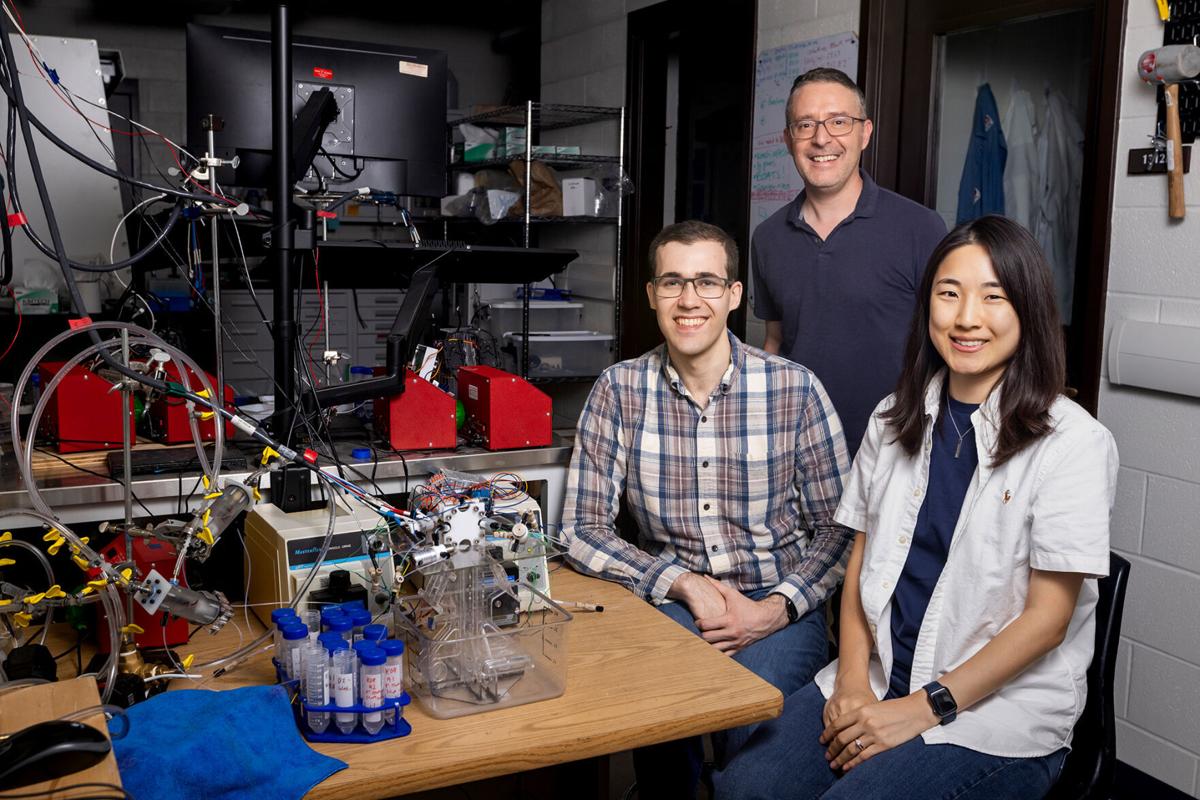
The results of the study by mechanical engineering and science professor Kyle Smith, Illinois graduate students Paul Rozzi and JeongA Lee, and Chip Roberts and Tim Arthur from the Toyota Research Institute of North America are published in the journal Environmental Science and Technology.
People are also reading…
Most climate scientists agree that even with aggressive cuts in current emissions, the world is unlikely to meet climate targets without also removing some of the CO2 that has already accumulated over decades. Most current carbon-capture technologies work at point sources — places like power plant smokestacks where CO2 emissions are high.
“Point source methods are important, but they don’t deal with the vast amount of CO2 already mixed into the air at much lower concentrations,” Smith said. “Our work is aimed at that legacy problem.”
A key advance of this work is the device’s use of specialized potassium-stabilized manganese dioxide electrodes and a specific method for moving charged particles. In the lab, the team uses an electrochemical cell to change the pH of a saltwater solution. In one step, the solution is made more alkaline, allowing it to absorb CO2 from the air effectively. In another step, the solution is made less alkaline again, which causes the CO2 to bubble back out in a purified form, ready for storage or reuse.
“What’s innovative about our work is that we use proton‑intercalation electrodes in what we call a cation‑compensated cell,” Smith said. “That design lets us operate in an alkaline range where CO2 is much more soluble, which is crucial for making direct air capture practical.”
To make the system as efficient as possible, the team treated the process much like a classical thermodynamic cycle, in the spirit of the cycles engineers use to design power plants. Instead of thinking in terms of pressure and volume, the team mapped out their cycle using dissolved inorganic carbon and potassium ion concentration in the solution.
“By framing our process as a thermodynamic cycle in this particular space, we could see where energy was being wasted and how to redesign the cycle,” Lee said.
While the early results are promising, the team said that there is still work to do before this technology can be deployed at large scale. For example, the device uses two liquid streams that ideally should remain separate. In practice, some mixing occurs when flows are switched, reducing efficiency.
“Inter‑stream mixing is one of the biggest issues we’re dealing with now,” Rozzi said. “If we can limit that mixing or design around it, we can significantly improve both energy consumption and productivity.”
Toyota Motor North America; the Campus Research Board at the U. of I., through an Arnold O. Beckman Award; the department of mechanical science and engineering; and The Grainger College of Engineering supported this research.
“Our work with Professor Smith and the U. of I. team on electrochemical direct air capture provides useful insights into how materials, electrochemistry and process design can be combined to address challenging CO2 separation problems,” Roberts said. “This type of early-stage research supports Toyota’s broader effort to explore innovative pathways toward long-term decarbonization.”
Smith declares U.S. Patent Application 18/713,023, which is owned by the U. of I. Smith, Lee, Rozzi, Roberts and Arthur declare U.S. Patent Application 19/368,311, which the U. of I. and Toyota jointly own.