
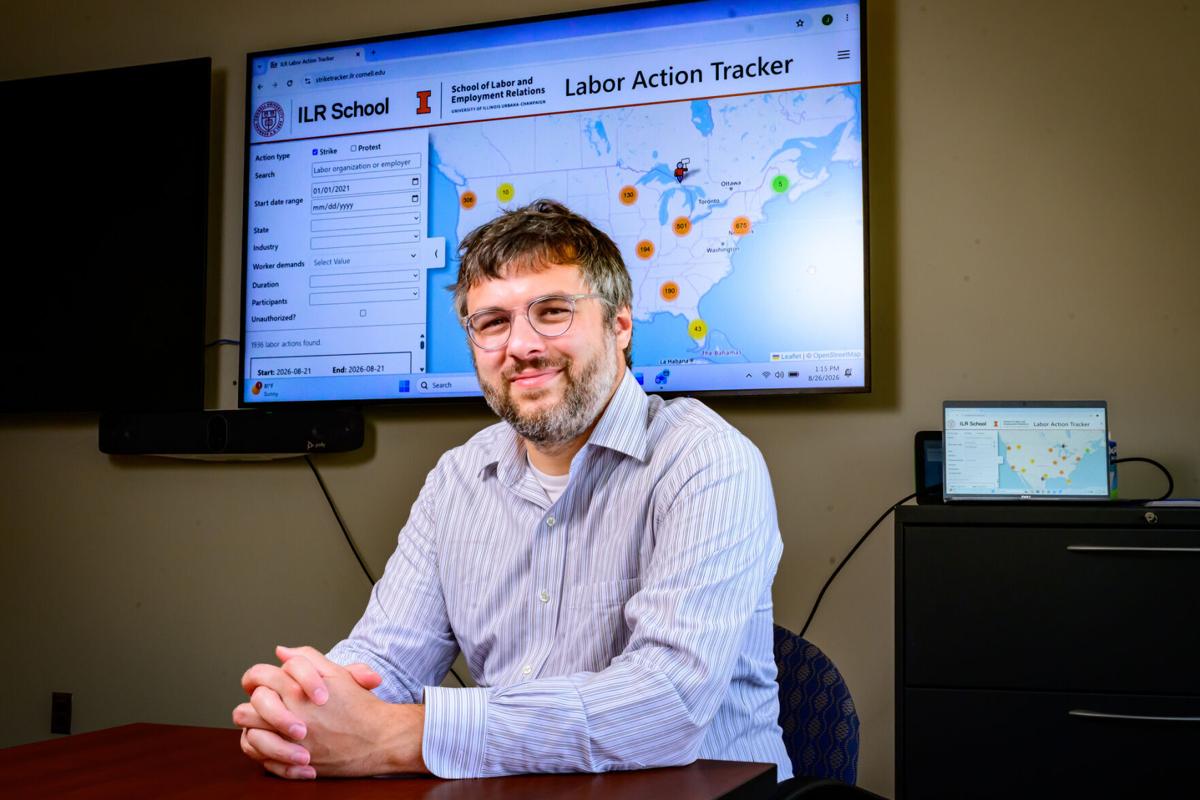
Johnnie Kallas is a professor of labor and employment relations at the University of Illinois Urbana-Champaign and the director of the Labor Action Tracker project, a comprehensive database of strike activity in the U.S. Kallas, a labor scholar who studies strikes, labor militancy and union revitalization in the U.S., spoke with News Bureau business and law editor Phil Ciciora about recent trends in labor strikes and labor protest activities.
What is the Labor Action Tracker?
The Labor Action Tracker provides a comprehensive database of labor strikes and labor protest activity across the U.S. to better inform and support labor movement activists, policymakers and scholars.
As a graduate student, I led the team that developed the database in late 2020 for two main reasons. First, that was a time of a lot of broader labor and social unrest during the COVID-19 pandemic, and also in response to the murder of George Floyd, which itself sparked a number of protest activities. So we wanted to create a database that would accurately capture labor strike activity in the U.S. There have been longstanding limitations on official data sources from the U.S. Bureau of Labor Statistics dating back to the early 1980s, as they have only documented particularly large work stoppages involving a thousand or more workers that last at least an entire shift.
People are also reading…
So there was this real data gap, and we wanted to fill that gap with the Labor Action Tracker.
Second, we wanted to amplify and account for the voices of workers who are out on the picket lines, regardless of the size of the strike, regardless of whether workers were unionized or not.
What trends have you noticed since 2021?
We documented a relative increase in strike activity from 2021-23, and in 2023 there were more strikes and considerably more workers on strike than in any other year captured from 2021-25.
Since then we have seen a little bit of a decline in both 2024 and 2025. But one of our most surprising findings is that about a quarter of all the strikes that we have documented since our project began have been organized by nonunion workers.
This is very surprising because when you think of strikes, you often think about big unions. Now, 90% of workers in the U.S. are nonunion, so maybe it makes some sense. And those nonunion strikes tend to be a lot smaller for a variety of reasons than strikes by unionized workers and, consequently, are not captured in the BLS numbers. But it is still a higher percentage of strikes organized by nonunion workers than I certainly would have guessed going into the project.
There has also been a lot of concentration, especially in the last three years, of strikes in the western part of the U.S., particularly in California. About two-thirds of all striking workers came from California in 2025, so there has been a large amount of activity on the West Coast, and I think what has been driving that is the cost of living crisis coupled with rising inflation.
For a more local angle, workers and unions certainly organize strikes in Illinois, more so than in many other Midwestern states. I am the co-author of the recently published Illinois Labor Action report, which found that, from 2021-25, workers in Illinois organized 123 strikes involving approximately 36,173 workers.
What drives year-to-year variation in labor activity?
A lot of what is driving the number of workers on strike are those unionized strikes. Typically, the kind of year-to-year variation we see in the number of workers on strike is mostly due to the size of large bargaining units that happen to have a contract that is expiring. Unionized workers are generally prohibited from striking by "no strike" clauses during the duration of a contract. They go on strike when a contract expires.
For example, in 2023, which was the largest year of striking workers in the last five years, we also witnessed a lot of very large bargaining units with expiring contracts. 150,000 United Auto Workers members faced a contract expiration at the Big Three automakers, and about 50,000 of them participated in the "Stand-Up" strike. That contract expired. About 175,000 actors and writers as part of SAG-AFTRA and the WGA had contracts expire. Both groups also went on strike.
So it is not total happenstance because there are economic and quality of life reasons, but contract expiration dates certainly play a big role.
How have worker attitudes toward strikes changed?
To put this in historical context, strikes were really viewed as sort of a last defense mechanism for unions and workers earlier this century. Unions did not want to go on strike because striking is incredibly risky for both unions and individual union members. Even if you have a robust strike fund, you are sacrificing pay. You do not always know when the strike is going to end. It is an incredible gamble to undertake.
So for a long time, it was really viewed as a last resort. I think what changed is that, during the pandemic and postpandemic era, unions started viewing strikes as more of an offensive tool to secure gains, rather than as a last resort against concessionary bargaining by employers.
If you are a frontline healthcare worker who went through the hell of the pandemic only to receive a 1% or 2% wage increase, you might have more than a little righteous anger. You put your life on the line for patients in 2020 and 2021, and now you cannot afford your bills.
I do not think it is any mystery that the broader structural factors of inflation and affordability have really driven a lot of the labor militancy we are seeing, especially in public-facing sectors such as healthcare and education.